



Best Practices for Enhancing AI Visibility in 2026
Last Updated on January 4, 2026 by Valerie Jennings
AI engines now decide which brands get seen.
If they’re not pulling your content, your visibility is already shrinking.
In this guide, we’ll walk through best practices to enhance AI visibility so your brand shows up in the answers customers trust.
Want your brand to stand out in AI search?
JSMM delivers strong AI visibility strategies for you.
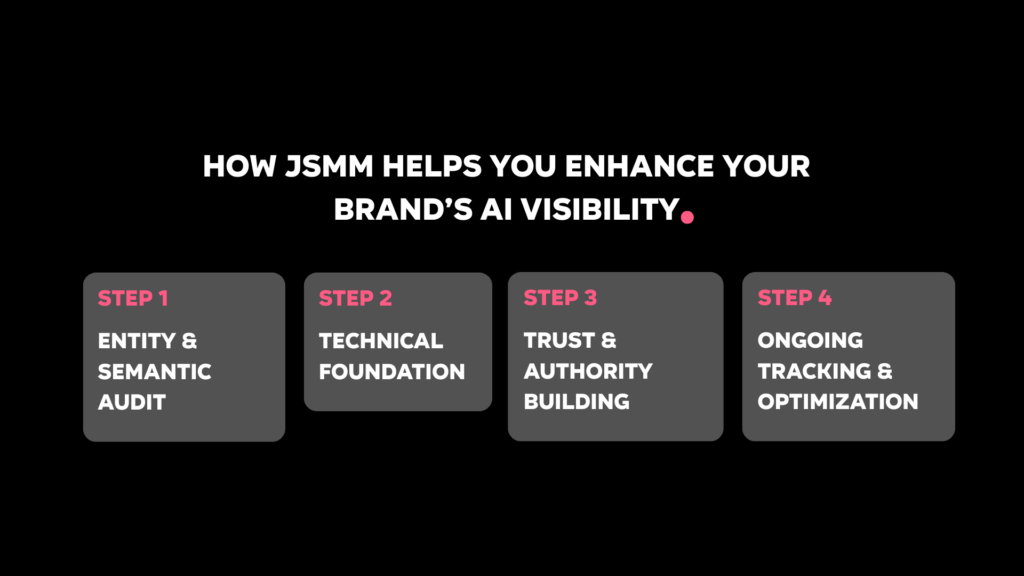
Our clients see real results, like 133 pages cited and 16,000 monthly AI audience reach. We focus on entity clarity, structured content and the signals generative engines trust. If you want your brand to show up where customers ask their questions, contact us for a personalised AI visibility audit.
What are the best practices for enhancing AI visibility?
AI visibility improves when content is structured, entity-driven, and written in a clear question-and-answer format that generative engines can extract, trust, and cite across platforms.
Key points:
- Write for Conversational Search Patterns
- Use the Direct Q&A Format
- Structure Content for AI Comprehension
- Strengthen E-E-A-T Signals for AI Engines
- Strengthen Entity Optimization Across Your Content
- Use Schema to Support AI Understanding
- Build Topic Clusters to Show Depth
- Strengthen Off-Site Content
How to Improve Content for AI Visibility
Below are the AI visibility best practices that you can integrate into your web content:
Write for Conversational Search Patterns
 AI tools now answer questions written in a natural, conversational way.
This means writing clearly, avoiding keyword stuffing and focusing on conversational queries that reflect real questions. Long-tail keywords help AI match your content to those questions with more accuracy.
How to Write for AI Conversations
Think about how you would explain a concept to someone unfamiliar with your industry.
Anticipate what they might ask. Answer those follow-up questions in your content. This helps AI understand intent, not just keywords, and it makes your content more useful to real people.
Here’s what to focus on:
- Target long-tail conversational keywords within your content.
- Add FAQ blocks that give short, direct answers.
- Write in a simple, conversational tone that AI can easily understand.
Where to find conversational long-tail keywords:
- “People Also Ask” sections of Google.
- Reddit and Quora threads related to your industry.
- Write about queries starting with “how to,” “what is,” and “best way to”
- Use free keyword research tools like Answer Socrates and Answer The Public.
Use the Direct Q&A Format
AI tools pull answers, not long explanations.
When your content follows a direct question-and-answer format, AI can recognize it as a clear response.
This makes your page more likely to appear when users ask similar questions.
How to Apply the Q&A Format for AI visibility
- Identify the questions your audience asks most.
- Place a direct answer near the top of your section or page.
- Use question-based H2 or H3 headings.
Strengthen E-E-A-T Signals for AI Engines
AI engines look for strong E-E-A-T signals to decide whether your content is trustworthy.
These signals show your:
- Experience
- Expertise
- Authority
- Trustworthiness.
Clear author bios, transparent citations and consistent brand trust signals help AI understand why your content should be surfaced.
Why High-Authority Content Matters More for AI Visibility
Many leading companies now hire journalists, editors and researchers to create their content. They do this because AI rewards expert-made, original work.
For example, Wells Fargo hired a former journalist from the U.S. News & World Report as their Editor-in-Chief. In today’s zero-click environment, earned media matters more than ever. AI engines favor trusted sources and unique insights that originate from authoritative publishers.
How to Build Strong E-E-A-T
Focus on creating content that goes deeper than what already exists online.
Add insights, examples and explanations that only an expert with real experience could provide. This depth is one of the strongest trust signals for AI because it shows your content has true subject-matter value.
What to include:
- Authority signals: Add credentials, certifications or real case examples to show real-world expertise.
- Expert bios: Make it clear who wrote the content and why they’re qualified to teach the topic.
- Transparent citations: Use reliable sources such as:
- Government websites (e.g., .gov sites)
- Academic journals or university research
- Industry associations or trusted organizations
- Peer-reviewed studies
- Reputable media publications
- Updated timestamps: Add publication and revision dates to show that your content is current.
- High-quality, original insights: Add depth, personal experience, unique examples and explanations that demonstrate true expertise.
Structure Content for AI Comprehension
AI engines understand your content faster when the structure is clean and predictable.
Short paragraphs, clear headings and simple bullets help AI process meaning without confusion.
This kind of structured content also makes your page easier for people to skim and understand.
Based on Semrush data, 92% of AI Mode responses included a sidebar showing ~7 unique domains. This is proof that structured layout (lists, sections, named entities) increases the odds of being included in an AI answer’s reference panel.
How to Create an AI-Friendly Formatting
What to include:
- Short paragraphs and TLDR summaries.
- Step-by-step bullets to explain processes in order.
- Clear H2 and H3 headings to guide meaning.
- Complex terms defined in simple language.
- Consistent formatting patterns across your pages
- Key takeaways, so AI can pull them easily.
Strengthen Off-Site Content
AI engines evaluate your brand based on everything said about you across the web, not just what you publish on your site.
This means off-site visibility is a major factor in AI search results. As a part of this strategy, you should also be building your content on UGC (User-Generated Content) platforms.
In the past year, UGC-rich platforms like Reddit, LinkedIn, YouTube, Quora, Yelp and Tripadvisor gained more visibility. While evergreen sites such as Stack Overflow, Chegg, Britannica and History.com experienced sharp traffic declines.
Reddit alone appears in 40% of citations across ChatGPT, Perplexity, AI Mode and AI Overviews, making it the largest single source of information for generative engines.
This is why your brand needs to build a presence in those UGC environments: that’s where AI is getting its signals, citations and understanding of which brands are trustworthy and credible.
Why this works:
- AI increasingly cites Reddit and UGC sources.
- These platforms offer a real, unbiased user experience.
- Joining these conversations gives AI more reasons to trust and surface your brand.
How to Build Off-Site Authority
- Encourage reviews on platforms like Google Business Profile, G2 and Trustpilot.
- Join discussions in online communities or industry forums like Reddit, Quora, LinkedIn Pulse and niche forums.
- Pitch contributed articles to reputable publications so your brand appears in credible, third-party sources.
Strengthen Entity Optimization Across Your Content
What are entities?
Entities are the specific names, concepts and topics that help generative engines connect related ideas and interpret your content with precision.
In simple words, entities are the important “things” in your content that tell AI what you’re talking about.
This is why entity optimization matters. AI depends on strong, steady entity signals to interpret your content.
When those signals are clear, AI can connect your ideas more easily and decide that your page is trustworthy enough to surface in its answers.
How to do Entity Optimization
For example, your brand sells email marketing software. Your core entities might include terms like email automation, deliverability, segmentation, marketing workflows and email campaigns.
When these terms appear across your pages in a clear and natural way, AI starts to understand what your brand does and how your content pieces relate to one another.
Here’s what else you can do:
- Repeat your core entities naturally across articles, landing pages and FAQs.
- Add simple examples that show how each entity applies in real situations.
- Use internal links to connect related topics and help AI map your site structure.
 Use Schema to Support AI Understanding
 Use Schema to Support AI Understanding
What is schema markup?
Schema markup is code added to your page that labels important information for AI systems. In simple terms, it works like a set of tags that tells AI, “This is a question,” “This is an answer,” or “This is a step-by-step guide.”
Schema markup helps AI understand your content by providing structured data it can quickly parse. It tells AI what your page includes, how it’s organized and which parts answer specific questions.
How To Use Schema to Support AI Understanding
- Add FAQ schema to support conversational coverage.
- Add How-To schema for clear, instructional content.
- Keep your structured data accurate and up to date.
Build Topic Clusters to Show Depth
Topic clusters help AI understand how your content connects and which subjects your brand knows well. Instead of treating each blog post as a standalone page, you create a network of related content that builds meaning and depth.
When AI sees this structure, it begins to view your site as a reliable source with strong topical authority.
How Topic Clusters Strengthen Visibility
A simple way to build topic clusters is to use a hub-and-spoke model. Create one main pillar page that covers a broad topic. Then develop shorter pages that explore specific subtopics. Link all of these pages to one another and use clear, descriptive anchor text. This helps AI better follow the relationships between your ideas.
When these pages link together, AI doesn’t just see isolated articles; it sees a complete ecosystem of information.
How to build strong topic clusters:
- Use a pillar page to cover the main topic.
- Create cluster pages that address subtopics.
- Link all cluster pages back to the pillar using descriptive anchor text.
- Link high-authority pages to newer articles.
- Avoid vague anchor phrases like “click here.”
What AI Visibility Optimization Is NOT
- Not keyword stuffing
- Not automation-only
- Not a one-time setup
- Not replacing SEO fundamentals
Multi-Engine Best Practices for AI Visibility
Every AI engine retrieves and surfaces content in its own way.
To increase your visibility across the full AI ecosystem, your content needs to meet the specific preferences of each engine.
- Google AI Overviews (SGE): Google’s AI layer that summarizes search results. It prefers structured, factual content supported by schema markup and strong E-E-A-T signals. It pulls answers from pages that are clear, credible and well-organized.
- ChatGPT: A conversational AI model that generates answers based on clarity, definitions and consistent explanations. It surfaces content that uses strong entities and simple, direct language that aligns with natural questions.
- Perplexity: An AI search engine that relies heavily on citations. It favors precise definitions, structured answers and content supported by trustworthy external sources. It often cites websites, UGC and authoritative resources directly.
- Bing AI / Copilot: Microsoft’s hybrid AI search tool that blends SEO and GEO signals. It rewards clear structure, authoritative information and traditional on-page SEO combined with AI-friendly formatting.
Increase Your Brand’s AI Visibility with Generative Engine Optimization by JSMM
Strong AI visibility will help your business appear where customers search for answers.
The right AI-driven digital strategies make that easier.
But doing it well takes time, testing and expert insights into how AI engines interpret your content.
JSMM can help you move faster by building content and structures designed for AI visibility.
Our team focuses on clarity, entities and consistency so your brand has a better chance of being surfaced across multiple platforms.
What sets JSMM apart:
- 20+ years of digital and MarTech expertise backed by real client results
- Our clients see an average increase of 50%+ in AI citations.
- We track your AI visibility with precision.
- We’re early adopters. We optimized for voice search when Alexa launched and adapted to Instagram SEO when keywords first mattered.
Get a FREE Personalized AI Visibility Audit
Most brands don’t know how AI currently interprets them. A visibility audit shows what AI sees before customers ever click.
If you want to see how AI engines currently understand and surface your brand, a personalized audit is the fastest place to start. We review your AI presence, identify what’s holding you back and show you the biggest opportunities you can act on right away.
Your audit includes:
- Your AI Trust Score: How AI systems evaluate your authority
- Technical Readiness: Where your structured data needs improvement
- Top 5 Citation Gaps: Opportunities your competitors are using
- Current AI Presence: Where you’re being cited or overlooked
- Priority Action Plan: The simplest steps to increase your AI visibility
Get Your Free AI Visibility Sample Search
Download the AI SEO Playbook
If you prefer to learn the fundamentals on your own first, you can download our free AI SEO Playbook. It covers the core techniques generative engines rely on and gives you clear steps you can apply right away.
Inside the guide, you’ll find:
- The sources AI systems trust most (and how to get cited)
- Content formatting techniques for easier AI extraction
- Schema markup strategies that strengthen entity recognition
- E-E-A-T signals that improve AI credibility
- Real examples and practical takeaways you can use immediately
