



What Is Generative Engine Optimization? A Guide for Beginners
Last Updated on January 4, 2026 by Valerie Jennings
AI is changing how people find information.
Tools like ChatGPT, Perplexity and SGE (Search Generative Experience) aren’t just summarizing the web. They’re choosing which brands appear in those summaries.
If your content isn’t optimized for how generative engines read and retrieve information, you’re already losing visibility.
For brands focused on smarter marketing and measurable results, understanding GEO is essential for staying visible in an AI-driven search world.
This guide explains what GEO is, how it works and why it matters for every business.
Want your brand to show up in AI-generated answers?
If you are serious about being visible in AI search results, our AI SEO Playbook shows you exactly how to make it happen. It breaks down the sources AI systems trust, the formatting structures they extract from, the schema strategies that strengthen entity recognition and the E-E-A-T signals that drive citations.
Download our FREE AI visibility guide
What Is Generative Engine Optimization (GEO)?
Generative engine optimization (GEO) is the practice of shaping your content so it can be easily understood and selected by AI search tools like ChatGPT, Perplexity and Google’s AI Overviews.
This article covers:
- What Is Generative Engine Optimization?
- Why Generative Engine Optimization Matters For Businesses
- GEO vs SEO: What’s the Difference?
- Why SEO and GEO Must Work Together
- How Generative Engines Evaluate Your Content
- Examples of GEO in Action Across Different AI Engines
- A Simple GEO Content Checklist for Beginners
- How AI Search Will Transform Marketing
Why do you need to do Generative Engine Optimization (GEO)?
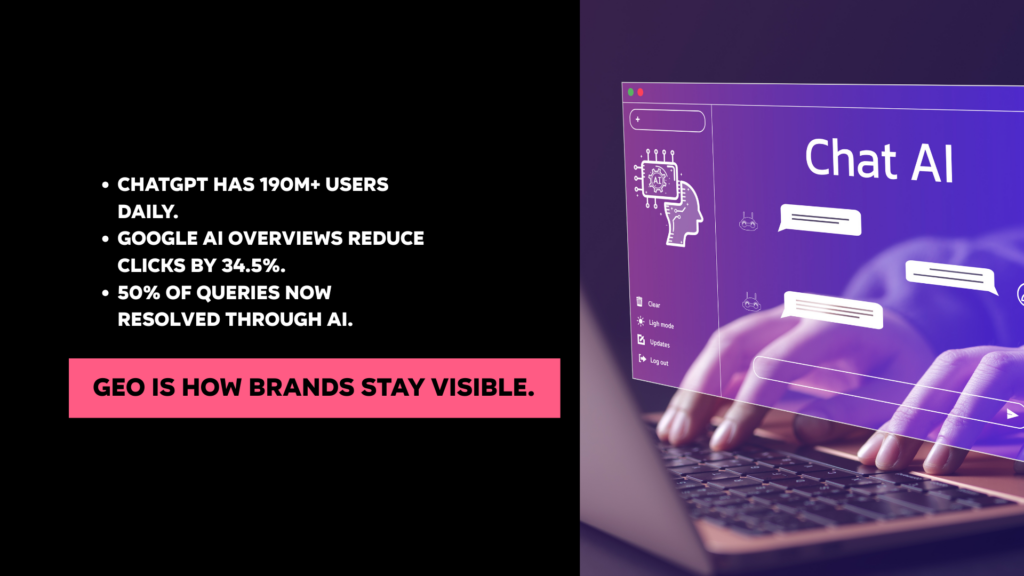 Search is changing fast. AI tools now play a major role in how people get information.
ChatGPT alone has more than 190 million users and handles up to 2.5 billion prompts a day, meaning millions of questions never reach Google at all.
Google has confirmed this transition. In an interview with The Verge, CEO Sundar Pichai said, “AI-generated answers will become one of the main ways people interact with Google over time.”
This shift also changes the economics of visibility. Ahrefs found that when an AI Overview appears, the top-ranking organic page in Google loses 34.5% of its clicks.
In simple terms: AI platforms now decide which content gets seen.
And Generative Engine Optimization involves key strategies that can help your content appear on AI search tools.
Why Does Generative Engine Optimization (GEO) Matter for Businesses
AI-generated answers are becoming the primary source of information, the place where customers compare solutions and the basis for decision-making. If your content isn’t optimized for AI, your brand won’t appear where these buyer decisions happen.
GEO helps fix that. It increases your chances of being included in AI answers across ChatGPT, Perplexity, Google’s AI Overviews and more.
GEO vs SEO: What’s the Difference?
Generative engine optimization (GEO) and search engine optimization (SEO) both help people find your content online.
But they work in different ways.
SEO helps your pages show up in Google’s traditional search results. GEO helps your information appear in the answers generated by AI tools like ChatGPT, Perplexity and SGE.
Key Differences at a Glance
| SEO | GEO |
| Optimized for search engine crawlers | Optimized for generative engines |
| Target rankings in traditional search results | Targets retrieval and inclusion in AI summaries |
| Relies heavily on keywords | Relies on clear language, entities and structured explanations |
Why SEO and GEO Must Work Together
SEO and GEO aren’t competing strategies. They support each other.
SEO builds the strong content foundation that AI engines learn from, while GEO makes that content easier for generative systems to understand, summarize and cite.
How they work together:
- SEO builds authority and helps search engines trust your content.
- GEO increases the likelihood that your content appears in AI-generated answers.
- Together, they expand your visibility across both traditional search and generative search channels.
Benefits of combining SEO and GEO strategies:
- At the top of the funnel, SEO drives discovery.
- In the middle of the funnel, GEO places your brand directly in AI explanations where buyer decisions are often being formed.
- At the bottom of the funnel, both support higher trust and stronger engagement.
For modern digital marketing, the strongest results come from using SEO and GEO as one integrated strategy, not treating them as separate efforts.
How Generative Engines Evaluate Your Content
So, how does AI decide whether your content is worth showing on its platforms?
Generative engines look for meaning, clarity and structure. They try to understand what your page is about, how trustworthy it is and whether it can help answer a user’s question.
To do this, AI models rely on a few core signals that determine whether your content is shown in an AI-generated response.
Below are the different factors AI looks for in your content:
- Clarity, Structure and Completeness
AI models look for content that explains ideas clearly and consistently.
They prefer clear definitions, step-by-step explanations and content with very little ambiguity. When your writing follows a simple structure, AI systems can process it faster and more accurately.
- Entities and Semantic Meaning
Entities are the core concepts, names and topics that AI models identify and categorize when reading your content. Strong entity optimization helps generative engines understand your content structure and evaluate contextual clarity.
In simple terms, entities are the specific names, ideas or things that AI uses to understand what your content is about.
For example, if your brand is XYZ Home Services and your content repeatedly mentions air conditioning repair, HVAC maintenance and energy-efficient cooling, AI tools will recognize those entities as connected. This helps generative engines understand that your content is about HVAC services, even before analyzing every sentence.
- Schema Markup and Structured Data
Schema markup is a type of code that gives AI extra information about your content’s meaning and structure. Technically, a schema helps generative engines recognize key elements, such as questions, steps, products or reviews, so they can pull the right details into an answer.
Simply, schema tells AI what each part of your page is.
A Simple GEO Content Checklist for Beginners
Before you start optimizing for generative engines, it helps to run your content through a quick checklist. This beginner GEO guide keeps everything simple and ensures your pages are ready for AI search.
Technical Essentials
- Did you define your key entities?
- Did you add schema markup (FAQ, How-To, Article)?
- Is your content structured with clear H2s and H3s?
- Does your page include contextual clues that improve semantic understanding?
- Is the information up to date?
Content Essentials
- Is your main definition clear and easy to find?
- Do you provide examples that help AI interpret meaning?
- Does the content answer conversational queries?
- Is your brand clearly attributed?
If you want support turning this checklist into a full GEO-ready content framework, JSMM helps brands build AI-friendly content systems that improve visibility across search, generative engines and the full digital funnel.
Who GEO Is NOT For
- Brands with thin or one-page websites
- Content without clear structure or definitions
- Teams that are unwilling to update content over time
- Businesses relying only on short-term ad traffic
Examples of GEO in Action Across Different AI Engines
Generative engines don’t all pull information the same way. Each platform uses its own method to read, interpret and summarize content.
Google (Search Generative Experience) Example:
Google’s SGE pulls short, structured summaries from content that shows clear expertise and direct explanations.
ChatGPT Example
ChatGPT often blends multiple sources and prefers content with strong clarity, definitions and entity consistency.
Perplexity Example
Perplexity favors highly structured content with strong citations and clear source signals, making retrieval more precise.
Why GEO Requires Ongoing Monitoring (Not One-Time Optimization)
AI search isn’t stable.
Data from the AI Visibility Index shows that the entire ecosystem shifts every month.
Across 2,500 real-world prompts, researchers observed constant changes in brand mentions, source diversity and model behavior across ChatGPT and Google AI Mode. ChatGPT increased its source diversity by 80% in a single month, while Google AI Mode tightened brand mentions but still raised diversity by 13%.
In simple words: AI tools keep changing what they cite and who they trust. Brands must continuously monitor and adjust their GEO approach.
But most teams don’t have time to track these changes or adjust their content.
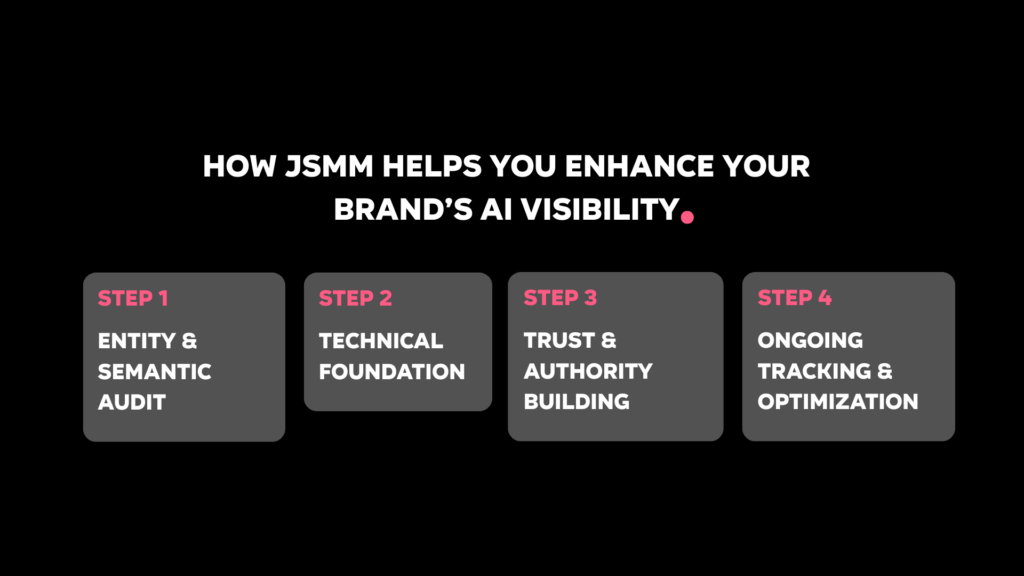
JSMM does this for you. We monitor how different AI engines behave, update your content as patterns shift and strengthen your GEO signals so your visibility doesn’t drop without warning.
Book a personalized AI visibility audit.
Increase Your Brand’s Visibility Across Every AI Search Platform
 AI search tools are now the first place people go for answers.
It’s where customers learn about brands.
It’s where they compare options.
It’s where they decide to buy.
If your brand isn’t showing up in these AI-generated answers, you’re losing visibility at the exact moment customers are making decisions. That’s why GEO matters. It helps your brand stay visible, discoverable and competitive in an AI-first world.
JSMM builds GEO-ready content and digital structures that AI systems can easily understand, trust and surface across every major search platform.
Why brands partner with JSMM
- 20+ years of digital and MarTech expertise backed by real client results
- Our clients see an average increase of 50%+ in AI citations.
- We track your AI visibility with precision.
- We’re early adopters. We optimized for voice search when Alexa launched and adapted to Instagram SEO when keywords first mattered.
If you want to explore what GEO content could look like for your brand, contact us today or book a personalized AI visibility audit.
FAQs
How do I do GEO for my website?
Start by auditing your content for clarity, structure, entity usage and schema, then rewrite or reorganize pages so AI can understand them easily.
How do I improve my GEO?
Focus on clear explanations, strong entity signals and structured content that AI systems can easily interpret.
What are some examples of GEO?
GEO includes optimizing definitions, FAQs, how-to guides and structured explanations so AI can pull them into summaries. It also includes strengthening entities and adding schema to help generative engines understand your content.
