



Digital Marketing Trends 2026: Why AI Systems Will Outperform Traditional Campaigns
Last Updated on February 16, 2026 by Valerie Jennings
Digital marketing trends in 2026 are not about adding another tool to your stack.
For years, I helped brands improve individual levers. Better ads. Stronger SEO. Smarter email flows.
You may still be doing the same. Those tactics matter, but they no longer compound on their own.
When your channels operate in silos, performance stalls. I have learned that integration is now the real advantage. You need systems that share data and learn across the full customer journey.
The brands pulling ahead are not simply running better campaigns. I see them building smarter ecosystems. When you design around AI-driven systems instead of isolated tactics, feedback loops shorten and decisions get sharper.
That is the shift I believe defines 2026. Marketing is no longer about tweaking parts. It is about engineering the whole.
What are the Digital Marketing Trends in 2026?
Digital marketing trends in 2026 focus on system-led growth, AI-driven discovery and full-funnel alignment across channels. Brands that connect content, paid media, SEO, creators and attribution into unified AI-driven marketing systems outperform campaign-based approaches.
Why Digital Marketing Trends in 2026 Point to a Structural Reset
Once you accept that growth now depends on connected systems, the next issue becomes obvious.
Most marketing setups were never built for this level of interaction.
Paid media, content, SEO, creators and automation now affect each other at the same time, which pushes complexity past what manual management can handle.
This is where many teams get stuck.
Adding more tools or optimization layers only creates more noise.
Without the right marketing infrastructure, fragmentation leads to wasted spend, unclear attribution and slower decisions.
Why AI Systems Outperform Traditional Campaigns in 2026
Once marketing becomes interconnected, campaigns start to fall short. Traditional campaigns are built around fixed timelines, isolated channels and static assumptions. They work in bursts. AI systems work continuously.
The key difference is how learning happens.
Campaigns optimize one moment at a time. When the campaign ends, learning often resets.
AI systems learn across the entire journey by connecting signals from discovery, content, influence and conversion in real time. Every interaction improves the system instead of living in a report.
This is why AI systems outperform campaigns in 2026.
They adapt while people are still moving through the funnel. They respond to changes in behavior, intent and demand as they happen, not weeks later. Instead of guessing what worked, you see cause and effect clearly.
For marketers and business owners, this changes expectations.
You’re no longer choosing between channels or tactics. You’re building a system that gets smarter over time. When everything is connected, performance compounds instead of resetting with every new campaign.
 Full-Funnel Systems Replace Isolated Campaigns in 2026
 Full-Funnel Systems Replace Isolated Campaigns in 2026
The biggest shift is that channels don’t work on their own anymore.
You tweak creative on Meta and it shows up in Google results. You change spend on search and paid social starts converting differently. Everything is connected now.
Because of that, optimising one channel at a time just doesn’t work.
Clicks and impressions don’t explain how people actually move from first touch to conversion. What matters is seeing the whole journey and understanding how spend turns into real results.
That’s also what people on both sides care about.
Business owners want to know what’s driving revenue. Marketers want to know what to optimise next. Full-funnel thinking wins because it reflects how marketing actually behaves today, not how dashboards are organised.
Short-Form Content Becomes a Conversion Engine, Not Just a Branding Tool
If you’re using short-form content right now, you’ve probably felt this shift already.
According to HubSpot, short-form video is now the most leveraged media format by marketers, and it’s obvious why. It’s where attention is actually happening.
What’s changing in 2026 is why it works. It’s no longer just about views or reach. Platforms are prioritising saves, replies and conversations because those signals show intent.
Short-form video is no longer just a branding tool.
It does part of the selling by building familiarity and intent before anyone clicks.
When content is paired with a clear next step, you can finally see how it contributes to real outcomes, not just engagement.
Creators Become the Bridge Between Awareness and Action
Another big shift is where trust comes from.
Audiences respond more to creators than brands because creators explain things in a way that feels personal and unscripted. That trust reduces hesitation and makes it easier for people to move from interest to action.
So what should change next?
Creators can’t sit only at the top of the funnel anymore.
Content needs to lead somewhere. DM funnels, guided replies and simple follow-ups turn passive scrolling into conversations.
Without that bridge, even great content stays stuck at awareness instead of becoming demand.
AI Assistants Become the First Discovery Layer
What’s changing in 2026 is where search actually starts.
People aren’t browsing first. They’re asking questions and letting AI narrow the field.
This shift compresses the journey.
According to University of Virginia’s research, 77% of people say AI helps them make decisions faster, which explains why traditional funnels feel slower and less predictable.
AI removes choice overload and delivers direction early.
What’s surprising is how much trust is already there.
Consumer studies from Bloomreach found that 46% of people trust AI more than a friend for certain product decisions. Not because AI is emotional, but because it’s perceived as objective. That changes how credibility is earned.
For marketers and business owners, this has real implications.
Discovery no longer starts with a click.
It starts with whether AI understands your brand well enough to include it in the answer. If you’re missing from that moment, you’re entering the journey late.
SEO Shifts From Rankings to AI Understanding
Because discovery now starts inside AI, SEO has to change with it. Rankings still matter, but they’re no longer enough. Visibility now depends on whether AI systems understand your brand clearly and confidently.
AI doesn’t evaluate pages the way search engines do. It looks for patterns across content, brand mentions, expertise signals and third-party references. Instead of asking “who ranks highest,” it asks “who makes sense to recommend.”
This is the real shift in SEO for 2026.
Success comes from being consistently understood across platforms, not just optimised on one page. When AI understands who you are, what you do and where you fit, visibility follows naturally.
Influence Shifts From Sponsorships to Measurable Activation
If creators are now driving real action, influence has to change too.
In 2026, digital marketing trends make one thing clear. One-off sponsored posts don’t carry the same weight they used to because they stop at exposure. Brands now expect influence to contribute to real growth, not just visibility.
This shift is about accountability.
Influencer marketing trends in 2026 are moving toward performance-based models where creator activity is tied to outcomes like leads, sales and qualified demand.
Influence is no longer treated as a brand expense. It’s becoming a measurable input into the funnel.
Why Performance Models Are Replacing Sponsorships
Flat-fee posts are easy to buy but hard to evaluate.
You might get reach, but it’s difficult to see what that reach actually did.
Performance and affiliate models change that by rewarding creators based on actions taken, not impressions served. This creates stronger alignment between creator partnerships and business goals.
Event-based creator activation is also playing a bigger role. Live launches, experiences and community moments generate content that feels real and unscripted.
That content doesn’t disappear after one post. It continues to support paid media, AI discovery and content systems long after the event ends.
Influence as a Funnel Input
What should change next is how influence is used.
When creator content is treated as part of the funnel, it supports awareness early and reinforces decisions later. Trust is built upfront, then carried through the journey.
When influence stays disconnected, performance stays unclear. But when it’s integrated into the funnel, it becomes easier to measure, optimise and scale. That’s the difference between influence as a cost and influence as a growth driver in 2026.
Why Digital Marketing Trends 2026 Favor Aligned AI Systems Over Bigger Budgets
Digital marketing trends in 2026 show that higher spend doesn’t fix broken systems. It often makes inefficiencies more obvious.
When channels, content and attribution aren’t aligned, demand moves through disconnected paths. Data lives in different platforms, insights show up late and optimisation becomes reactive. That’s why costs go up and payback slows, even when activity increases.
How Aligned Systems Change the Game
What actually improves performance is alignment.
When AI systems connect data across the full journey, signals from one channel inform decisions across others. Teams learn faster because insights aren’t trapped in silos.
This is where predictability comes in. Aligned systems make performance easier to understand, forecast and manage.
Instead of constantly testing and guessing, brands can scale with confidence because the system is doing the heavy lifting.
What Brands Must Do to Win Digital Marketing in 2026
Digital marketing trends 2026 reward leaders who move beyond campaign thinking. Growth now depends on how well systems work together, not how many tactics are deployed. This shift requires clearer priorities and stronger infrastructure.
Here’s where to focus next:
- Build systems, not campaigns, so results compound instead of resetting.
- Invest in AI infrastructure, not just tools, so data and decisions stay connected.
- Look at the full customer journey, not just channel metrics.
- Make sure you’re visible where AI shapes decisions, not only in ads or search results.
- Work with partners who operate as one team, not disconnected vendors.
When you make these shifts early, marketing becomes easier to manage instead of harder. You gain clarity, confidence and control. That’s what winning looks like in 2026.
Build a Marketing Strategy That Works in 2026
 If you want to get ahead, the focus has to shift.
You need visibility where decisions are formed, content that drives action and systems that show what’s actually working. That’s how you move faster with confidence instead of guessing with every campaign.
The challenge is that building this kind of system takes time and experience.
Most teams are still juggling tools, channels and vendors that don’t talk to each other. That’s where momentum breaks down.
At JSMM, this is exactly what we help you solve.
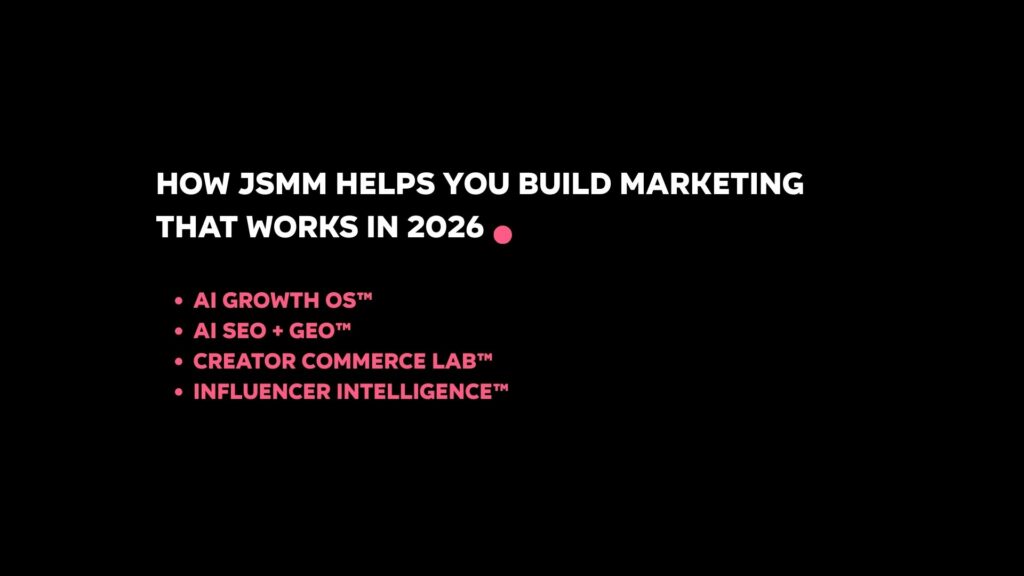
- AI Growth OS™ connects your paid media, funnels, automation and reporting into one system.
- AI SEO + GEO™ helps your brand show up earlier, where AI shapes discovery and trust.
- Creator Commerce Lab™ and Influencer Intelligence™ turn content and influence into measurable demand.
Together, these systems help you stay ahead of the shift and build marketing that actually works in 2026.
FAQs About Digital Marketing Trends in 2026
What are the most important digital marketing trends in 2026?
The most important digital marketing trends in 2026 focus on system-led growth, AI-driven discovery, and full-funnel alignment. Brands that connect paid media, SEO, creators and attribution perform better than those running isolated campaigns.
How is AI changing digital marketing in 2026?
AI is changing digital marketing by shaping how brands are discovered, compared and recommended before a website visit happens. Decisions are influenced earlier in the journey, which makes visibility and authority more important than clicks alone.
Are AI assistants replacing search engines in 2026?
AI assistants are not fully replacing search engines, but they are becoming a primary discovery layer. Many buyers now use AI tools to research options before turning to traditional search results.
What is AI SEO and how is it different from traditional SEO?
AI SEO focuses on entity authority, semantic clarity and being cited or recommended by AI systems. Traditional SEO prioritizes rankings and keywords, while AI SEO expands visibility into AI-generated answers and summaries.
Why do marketing systems outperform campaigns in 2026?
Marketing systems outperform campaigns because channels influence each other continuously. When media, content, SEO and attribution operate together, brands gain clearer insights and more predictable performance.
