



How Companies Use AI for Business Growth (And Why Most Get It Wrong)
Last Updated on April 29, 2026 by Valerie Jennings
A lot of companies are talking about AI for business growth right now, but not always in a useful way.
In many cases, the conversation jumps straight to tools, automation and speed.
What gets missed is the bigger question: what is AI actually helping the business do better?
In this article, I want to take a closer look at how companies are using AI for business growth, where the approach often falls short and what a smarter path may look like.
What AI For Business Growth Really Means
AI for business growth is not just about automating a few tasks. It is about using AI to improve how a business markets, sells and makes decisions.
That can include stronger content planning, better targeting, faster reporting, smarter lead follow-up and clearer visibility into what is driving revenue.
For some companies, that shows up in AI marketing. For others, it shows up in sales follow-up, reporting or customer experience.
In most cases, the real value comes when AI supports multiple parts of the business at once.
That is why this topic matters so much. AI is not only about doing more work. It is about helping the business make better choices with less waste.
Why Many Companies Get It Wrong
Many companies start with the tool rather than the problem. They hear that AI can save time, create content, automate work or improve efficiency, so they start adding it into the business right away.
But if the system behind growth is weak, AI often just makes the weak parts move faster.
The problem is usually not AI itself. It is using AI without enough clarity around what the business is actually trying to improve.
They Speed Up Activity Instead Of Fixing The System
One common mistake is using AI to increase output before fixing the path from attention to revenue. A company may use AI to produce more blogs, launch more ads, automate more follow-up or generate more reports, but still struggle to turn that activity into real growth.
More Content Does Not Fix Weak Positioning
For example, a business may publish more AI-assisted content every week, but the market still does not understand what makes the company different.
The content may be clear enough on the surface, but the positioning is weak. It talks about services in broad, generic terms instead of addressing a specific buyer problem, industry need or growth outcome.
In that case, AI helps the company say more, but it does not help the company say something more valuable. The business looks more active, but it does not become more persuasive.
More Automation Does Not Fix A Weak Conversion Path
The same thing can happen after the click. A company may automate follow-up emails and add chatbot sequences, but if the offer is weak, the landing page does not match the ad, or the lead handoff is confusing, those automations will not fix the real issue.
They just move more people into a weak conversion path. That is why this approach fails. The company is scaling output before it improves the parts of the system that actually drive growth.
What Works Better Instead
A better approach is first to fix the positioning, clarify the offer and tighten the conversion path. Then AI can help the business scale something that is already more likely to convert.
They Treat Teams And Functions Like Separate Parts
Another issue is the disconnect. Marketing may focus on visibility. Sales may focus on meetings. Leadership may focus on revenue. Operations may focus on reporting. If those pieces are not connected, AI cannot solve that on its own.
Better Lead Volume Does Not Always Mean Better Growth
For example, marketing may use AI to improve ad targeting and bring in more leads. But if sales says those leads are low quality, and leadership is only looking at closed revenue, the business still has no shared view of what success looks like.
Marketing thinks performance is improving because lead volume is up. Sales thinks performance is weak because close rates are down. Leadership sees mixed signals and does not know where growth is actually slowing.
More Reporting Does Not Always Create More Alignment
Another common example is reporting. One team may use AI to summarize campaign results. Another may use it to track a pipeline. But if those systems are not connected, no one can clearly see whether increased engagement leads to better sales outcomes.
The business ends up with more insight, but not more alignment. That is why AI can improve individual functions without improving the business as a whole.
What Works Better Instead
Real growth usually comes when marketing, sales, reporting, and leadership work from the same growth model. That gives AI a better system to support, not just separate departments to optimize in isolation.
They Expect AI To Replace Judgment
AI can surface patterns, summarize data and automate tasks. It can’t decide what matters most for the business. It can’t tell you which tradeoff is worth making. It can’t replace strong strategy, leadership or clear priorities.
Better Suggestions Do Not Guarantee Better Decisions
For example, a team may use AI to identify trending topics, suggest new campaigns and recommend budget shifts.
On paper, that looks smart. But if no one steps back to ask whether those topics attract the right buyer, whether those campaigns support the company’s position, or whether those budget shifts align with the business goal, the company can end up optimizing for movement rather than value.
Better Metrics Do Not Always Mean Better Business Outcomes
The same problem shows up in decision-making.
AI may reveal that one campaign has cheaper leads or that one topic gets more traffic. But human judgment is still needed to ask better questions.
Are those leads qualified? Does that traffic support the pipeline? Is the business getting closer to its actual growth goal, or just improving a surface-level metric?
What Works Better Instead
That is why some AI efforts look impressive at first but do not go very far. The tool may be working, but the thinking around it is still too weak to support real business growth. AI becomes much more useful when leadership uses it to sharpen judgment rather than avoid it.
How Should Companies Use AI For Business Growth?
A recent McKinsey survey found that 72% of organizations have adopted AI in at least one business function, helping explain why AI is moving from experimentation to core business planning.
A smarter approach usually starts with a few questions. Where is growth slowing down? Where is the team losing time? Where is the business relying too much on guesswork? That is usually where AI can start creating value.
Start With A Real Business Problem
AI works better when it ties to a clear need.
That may be weak conversion, slow follow-up, poor visibility, disconnected channels or content that is taking too long to produce. Companies often get less value when they start with a tool before they are clear on the problem they want to solve.
This is one reason many AI efforts stall. The tool may work, but the business never defined what success should look like.
A smarter starting point is to identify the process, workflow or gap slowing growth, then apply AI there first.
Use AI To Improve Research, Planning And Foresight
One of the most useful ways companies use AI for business growth is to improve how they gather insight and plan.
AI can process large volumes of market, customer and performance data much faster than a team could manually.
That can help businesses spot patterns earlier, understand demand more clearly and make stronger strategic calls.
This is also where predictive insight becomes useful. AI can help businesses see where demand may be shifting, which audience behaviors are changing and where growth opportunities may be building. Used well, that can reduce guesswork and help teams make earlier, better decisions instead of reacting late.
Use AI To Strengthen Content And Visibility Systems
Many companies use AI to support content research, outlines, repurposing and optimization.
That can help teams publish more consistently without having to start from scratch every time. It also helps when the goal is not just more content, but a stronger visibility system tied to real search behavior and audience needs.
This works best when the strategy is already clear.
AI can help shape stronger topic clusters, improve on-page structure, refresh older assets and turn one strong idea into multiple useful pieces.
Done well, this can support both visibility and lead generation. Done poorly, it can create a lot of content that says very little.
Use AI To Improve Personalization And Customer Insight
AI can also help businesses group audiences by behavior, intent and engagement patterns.
That makes it easier to send the right message to the right person at the right stage. It can also help teams learn more from customer feedback, sentiment and interaction patterns so they can respond more effectively.
This matters because stronger personalization is not just about better messaging. It can improve targeting, follow-up, customer experience and conversion flow all at once.
Over time, that creates a compounding effect because the system gets better at matching people to the right message, offer or next step.
Use AI To Improve Lead Flow And Follow-Up
Some of the most useful AI applications happen after the click.
A business may be doing a decent job creating demand, but still losing momentum because leads are not routed quickly, follow-up is weak, or the handoff between marketing and sales is messy.
AI can help here by triggering next steps, qualifying leads, personalizing nurture and surfacing where leads tend to stall.
That can make the path from interest to action much smoother. Growth often breaks after the initial response, so stronger lead flow gives the business a better chance of turning attention into revenue.
Use AI To Improve Reporting And Decision-Making
Many teams still spend too much time pulling numbers, formatting updates and trying to explain what happened after the fact.
AI can reduce that drag by helping gather data, summarize changes and surface patterns faster. That gives leaders and teams more time to focus on analysis and action.
This is one of the most useful areas because reporting affects how quickly a company can make good decisions.
When leaders can see what is changing, what is slowing down and where results are coming from, it becomes easier to decide where to invest, what to fix and what to stop.
The point is not just faster reporting. It’s faster clarity.
Build The Data Foundation Before You Try To Scale AI
AI usually works better when the data behind it is clean, connected and easy to use.
If data is scattered across systems, inconsistent or hard to access, AI will struggle to produce useful insight. That is one reason some companies get stuck in small pilots that never scale.
A stronger data foundation helps AI move beyond isolated tasks.
It makes it easier to connect reporting, customer insight, lead flow and performance data into one usable system.
That is often what enables AI to support repeatable growth rather than one-off wins.
Integrate AI Into Existing Systems, Not Isolated Tools
Companies often get more value from AI when it is built into the systems they already use rather than layered into random tools with no cohesion.
That may include reporting dashboards, CRM-linked workflows, marketing automation, content systems or cross-channel campaign tools. AI tends to be more useful when it helps these systems work together.
This is also what helps businesses scale beyond basic pilots. Instead of running small experiments forever, they start using AI across connected functions that support the same growth goals.
Microsoft’s Work Trend Index says many leaders still lack a plan and vision to go from individual AI impact to applying AI to drive the bottom line, which helps explain why so many companies stay stuck in isolated pilots.
Keep Human Judgment In The System
The businesses getting the most value from AI usually don’t hand everything over to automation.
They are combining AI support with stronger human judgment, clearer ownership and better cross-functional alignment. Harvard Business School notes that human experience and judgment remain critical to decision-making because AI can’t guide long-term strategy on its own.
That matters because growth still depends on decisions.
AI can help surface what is changing. It can help organize information and reduce repetitive work. But people still need to decide what matters most, what fits the brand and what should happen next.
Signs Your Business May Be Ready For A Smarter AI Strategy
Not every business needs the same level of AI support at the same time. But there are a few common signs that the company may be ready for a more strategic approach.
Those signs often include:
- Demand exists, but growth feels harder to manage
- The team is busy, but visibility is weak
- Leads are coming in, but conversion feels uneven
- Channels are active, but they do not feel connected
- Reporting shows activity, but it is not clear what the business impact is
When those signs show up, the problem is usually not a lack of effort. It is a lack of system clarity.
Why AI for Business Growth Matters Now
AI is no longer a side conversation. It is becoming part of how businesses think about growth, visibility and efficiency.
But that also means the gap between companies that use AI as a shortcut and those that use it to strengthen their businesses is becoming more obvious.
That gap matters. The companies gaining more from AI are often not the ones using the most tools. They are the ones asking better questions, building stronger systems and staying closer to business outcomes.
That is what makes this topic more strategic than it may look at first. AI for business growth is not really a conversation about tools. It is a systems conversation.
Build Business Growth On A Stronger System
If you want to use AI for business growth more effectively, do not start with more tools. Start with a stronger system.
The businesses that tend to get more value from AI usually are not just producing more.
They are connecting visibility, lead flow, reporting and decision-making in a way that makes growth easier to manage and improve.
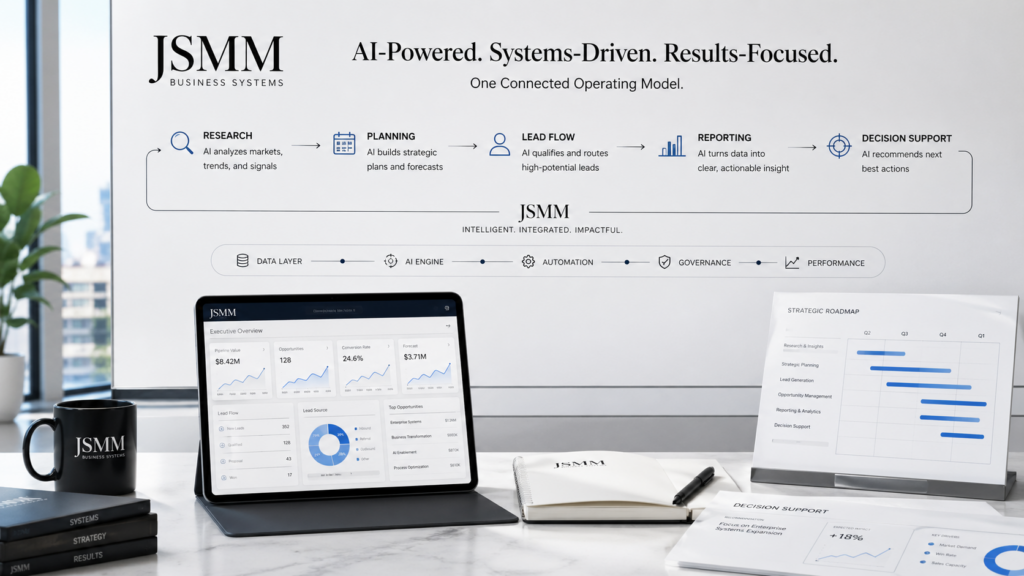
That is exactly what JSMM’s Growth Partner is built to support. It helps you:
- Build one clear growth plan so your channels, offers and goals work together.
- Connect demand generation and lead flow through ads, content, SEO and funnels.
- Improve conversion after the click with better follow-up, testing and nurture paths.
- See performance more clearly with live visibility into leads, pipeline and payback.
- Scale with stronger leadership so decisions stay focused on revenue rather than scattered activity.
When those pieces are connected, AI becomes much more useful.
Build a clearer path from AI-driven activity to measurable business growth.
Explore JSMM’s Growth Partner services
FAQs About AI for Business Growth
What is AI for business growth?
AI for business growth usually refers to using artificial intelligence to improve the systems that support visibility, lead generation, follow-up, reporting and decision-making.
How do companies use AI for business growth?
Companies often use AI for content planning, audience segmentation, lead qualification, reporting, conversion support and performance analysis.
Why do many companies get AI wrong?
Many companies get AI wrong because they start with tools before they are clear on the problem they need to solve. That can lead to more activity without stronger business outcomes.
Is AI for business growth only about marketing?
No. Marketing is a big part of it, but AI can also support sales flow, reporting, customer experience and leadership decision-making.
What should a company fix before adding more AI?
It usually helps to define the growth goal, identify the biggest bottleneck and make sure reporting connects activity to outcomes before scaling harder with AI.
