AI is everywhere right now but more tools do not automatically mean better marketing.
You still need a strategy that connects every stage of the customer journey and turns attention into action.
In 2026, the brands that stand out will be those using AI to support smarter decisions across the full funnel, not just to speed up tasks.
What is a full marketing funnel?
A full marketing funnel is the path people take from first discovering your brand to becoming a customer and staying engaged after the sale. It usually includes awareness, consideration, conversion and retention.
Here are seven steps AI helps strengthen a full-funnel marketing strategy.
Step 1: Identify Audience Intent Before Campaigns Launch
Start by using AI to pull together the signals your audience is already leaving behind. That can include:
Search queries and on-site search terms.
Review themes and competitor topic patterns.
Sales call notes and common customer questions.
AI can scan that language, group recurring pain points and surface emerging topic clusters so you can see what people care about before campaign planning starts.
Using AI gives you a clearer base for messaging, content planning and offer positioning because you have a strategy shaped by real market demand, not internal assumptions.
Step 2: Segment Audiences by Behavior and Buying Readiness
Next, use AI to segment audiences by what they do, not just who they are. It can read signals like:
Repeat visits and time on page.
Content downloads and email clicks.
Pricing, page views and return visits to key service pages.
This process helps you separate early research from active comparison and decision-stage intent, so your messaging matches real funnel momentum.
This point is where intent research becomes a strategic advantage. Google notes that today’s journeys are often unpredictable and nonlinear.
Instead of sending the same follow-up to everyone, you can create buyer-readiness segments and make nurture more relevant from the start.
Match Messaging to Each Funnel Stage
Once your segments are clear, shape the message around buyer readiness.
AI can show when someone needs education, proof or a stronger reason to act. That helps each message do its job and move the prospect forward.
Awareness stage: Use AI to spot when someone needs educational content, problem-focused messaging or a broader brand introduction.
Consideration stage: Use AI to find when a prospect is comparing options and needs proof points, use cases or clearer differentiation.
Conversion stage: Use AI to detect stronger buying signals and support messaging focused on trust, offer clarity and next steps.
Better sequencing: Deliver the right message at the right time, rather than repeating the same pitch.
Stronger funnel flow: When messaging aligns with the stage, the full-funnel strategy feels more cohesive and effective.
Step 3: Build Content for Each Stage of the Customer Journey
Then use AI to turn your research and segmentation into content with a clear job at every stage of the funnel.
LLMs: Help generate outlines, draft variations and repurpose content across formats.
Content intelligence tools: Help identify content gaps, topic clusters and high-value themes.
Workflow assistants: Help organize briefs, approvals and production tasks across the funnel.
This system helps you create awareness content that attracts attention, consideration content that builds trust, conversion content that drives action and retention content that keeps customers engaged.
Human strategy still shapes the voice, the quality and the points of differentiation.
That balance matters because AI may speed up execution, but strong performance still depends on human-led strategy, creativity and expertise.
HubSpot’s 2026 State of Marketing report makes this clear, noting that human-led marketing still wins trust and revenue.
Step 4: Choose the Right Channels for Each Funnel Stage
After that, use AI to decide where each message should appear based on performance signals.
Once you have mapped your content, match distribution to intent. AI can help place each asset where it is most likely to move someone forward in the funnel.
Awareness stage: Use AI to identify the channels that give your content a broader reach and stronger early brand visibility.
Consideration stage: Use AI to find where nurture content, retargeting and deeper education are most likely to keep prospects engaged.
Conversion stage: Use AI to place decision-focused messaging on the channels where users are most ready to act.
Why does AI work better across the full funnel instead of one channel?
AI works better across the full funnel because customer behavior does not happen in one place. People move between search, content, email, social and landing pages before they act. When AI connects those touchpoints, it improves targeting, sequencing and performance, rather than optimizing a single channel in isolation.
Step 5: Personalize Nurture Based on Behavior and Timing
Once your channels are working together, focus on what happens after the first touchpoint. AI can use systems like:
CRM platforms
Marketing automation tools
AI recommendation engines
These tools can tailor emails, content offers and follow-up sequences based on what someone clicks, views, downloads or returns to.
That makes nurture more relevant and timely, which helps move leads closer to action without turning the journey into generic automation.
How does AI make personalization more relevant in lead nurturing?
AI makes personalization more relevant by using behavioral signals to decide which message, content or offer someone should see next.
It can read actions such as clicks, page views, downloads and return visits through tools such as CRM platforms, marketing automation systems and recommendation engines.
Next-step recommendations: AI can suggest the most relevant follow-up based on engagement signals and content interest.
Smarter timing: It can trigger outreach when behavior shows a lead is more likely to respond.
Better journey flow: It can adjust the nurture path.
Step 6: Optimize the Path to Conversion
Once nurture is working, improve what happens right before the decision. AI can support that through tools like:
Conversion rate optimization platforms
Heatmaps and session recordings
AI testing tools
These systems can help you spot drop-off points, refine landing pages, strengthen calls to action and test message variations faster. That helps remove friction before conversion while still protecting trust and user experience.
Step 7: Measure Full-Funnel Performance and Refine the Strategy
After your conversion path is optimized, step back and measure what is working across the full funnel.
Use AI to connect insights from awareness, engagement, conversion and retention so you can spot patterns faster and make better strategic decisions.
At this point in the process, AI becomes a long-term optimization tool, helping you refine future content, targeting, and channel strategy based on full-funnel performance, not just final conversions.
What makes an AI full-funnel marketing strategy effective in 2026?
An effective AI full-funnel marketing strategy in 2026 uses AI to improve decisions at every stage, from intent research to conversion optimization. It also keeps human strategy in charge of positioning, messaging and business priorities. That balance is what turns AI from a tool into a real growth driver.
AI Works Best When It Supports Strategy Across the Full Funnel
By this point, the pattern is clear.
AI can make your marketing more efficient, improve targeting, sharpen personalization and speed up optimization across the funnel.
But it still needs a growth partner that can execute human direction. They will shape positioning, refine messaging and make sound business decisions, because strong performance comes from strategy first and automation second.
That is why the real advantage does not come from using more AI tools.
Build a Stronger AI Full-Funnel Marketing Strategy With JSMM
If your team is exploring how to use AI more effectively, the next step is not adding more tools for the sake of it.
The next step is to build a strategy that connects audience insights, content, distribution, nurturing and optimization into a single system that supports growth across the full funnel.
JSMM helps brands do that with a strategy-first approach that keeps AI aligned with business goals, brand positioning and measurable performance.
Instead of treating AI as a shortcut, the focus remains on using it to strengthen decision-making, improve execution and create more connected marketing.
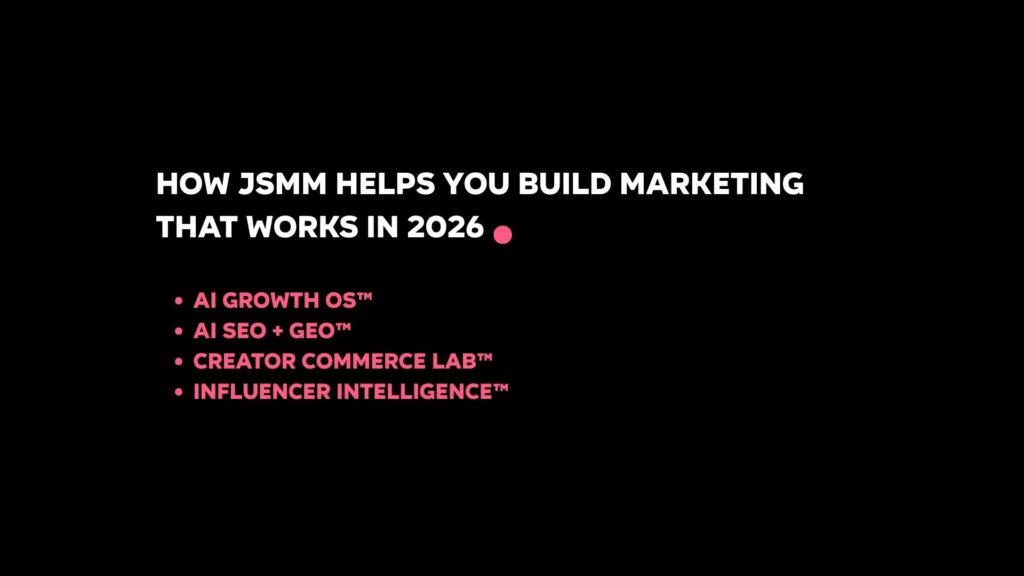
AI Growth OS™: A governed full-funnel growth system that combines strategy, paid media, funnels, AI and reporting into one KPI-driven engine.
Creator Commerce Lab™: A short-form video and UGC system built to turn creator content into leads, not just views.
AI SEO + GEO™: A visibility offer designed to help your brand show up in Google and AI search tools like ChatGPT, Gemini, Perplexity and Copilot.
Influencer Intelligence™: An influencer and event strategy built to drive authentic content, stronger reach and measurable ROI.
AI improves full-funnel marketing by helping teams find audience intent, segment leads, personalize messaging and measure performance more clearly. That makes campaigns more efficient and helps each stage of the funnel work together.
Can AI help with lead generation and conversions?
Yes. AI can support lead generation by improving targeting, content planning and channel selection, and it can support conversions by reducing friction on landing pages and in nurture flows. The greatest value comes when you integrate both into a single strategy.
Does AI replace marketing strategy?
No. AI can improve speed and efficiency, but it does not replace strategic thinking. You still need human direction for positioning, messaging, creative judgment and business decisions.
Why does a full-funnel strategy matter more in 2026?
It matters more in 2026 because buyers move across more channels, consume more content and use more AI-driven search experiences before they act. A full-funnel strategy helps you connect those touchpoints, making your marketing feel more relevant and perform more consistently.
CEO & Founder, Jennings Social Media & MarTech (JSMM)
AI-Powered Marketing Innovator | National Speaker | Award-Winning Agency Leader
Valerie Jennings is a transformative leader in digital marketing, known for pioneering AI-powered strategies that drive growth, innovation, and real business outcomes. She founded Jennings Social Media & MarTech (JSMM) in 2003 at just 24 years old.
Today, the agency serves a global client base ranging from publicly traded companies to small businesses across healthcare, technology, tourism, real estate, transportation, manufacturing, wealth management and medtech.
Under Valerie’s leadership, JSMM has developed and executed high-impact campaigns that combine AI-driven persona development, predictive analytics, geofencing, and digital advertising to deliver measurable results. One of her most successful campaigns for the Miami Beach Visitor Center resulted in a 115% increase in qualified leads, fueled by hyper-targeted creative and performance-based media.
In 2024, Valerie and her agency received 13 national and international awards, including:
🏆 Stevie Women in Business Award Finalist – Most Innovative Woman of the Year in Advertising, Marketing & PR
🏆 TITAN Women in Business Gold Winner – Innovative Marketing Executive of the Year
🏆 Cynopsis Top Women in Media – Industry Leaders, Senior Directors and Above
🏆 Inc. Magazine 2024 Power Partner – Recognizing JSMM’s trusted agency performance
She is also a national speaker on AI and digital transformation and holds an AI certification from Coursera, led by Dr. Andrew Ng, founder of DeepLearning.AI, co-founder of Coursera, and a Stanford computer science professor.
Valerie currently serves as chair of the Miami Beach Chamber of Commerce Tourism and Hospitality Council and leads a global team headquartered in Overland Park, Kansas, with satellite offices in Miami Beach, Florida, and Irvine, California. Her work continues to transform brands, inspire teams, and set the standard for what's possible in modern marketing.