AI is moving fast, but speed is not the same as strategy.
Many leaders feel pressure to act now.
They are told to automate faster, adopt more tools and integrate AI into every part of the business.
But that pressure often leads to this mistake: executing before they have built a clear AI strategy.
In my work with leaders navigating growth and transformation, I often see this tension.
The challenge usually is not whether AI can be used.
It is about making smart decisions about where it belongs before execution begins.
This article examines why leaders need to define an AI strategy first and how that thinking shapes a smarter path to execution.
What is an AI strategy?
AI strategy is the process of deciding how AI should support the business before you introduce tools or automation. It helps leaders define goals, risks, guardrails and the right role for AI in decision-making and execution.
Why should an AI strategy come before execution?
AI strategy should come before execution because AI can scale weak processes just as easily as strong ones. When leaders define the strategy first, they reduce risk and make execution more aligned, measurable and useful.
Even with all the momentum around AI, most companies are still early in figuring out how to use it well. McKinsey found that while almost all companies invest in AI, only 1% say they have reached AI maturity, underscoring the wide gap between adoption and effective execution.
What the Data Says About Moving Too Fast With AI Execution
Many leaders are under pressure to demonstrate AI’s value quickly, but that pressure does not eliminate risk.
Deloitte found that leaders continue to feel urgency about generative AI while naming governance as one of their biggest concerns, underscoring why strategy must come before rollout.
The companies seeing stronger results are not just layering AI onto existing work.
McKinsey found that companies get more value from AI when they rethink how work gets done and give senior leaders a clear oversight role.
Below, I’ll discuss actionable steps for planning an effective AI strategy.
Start With Business Reality, Not Technology
AI strategy does not start with software. It starts with business reality.
That means understanding how revenue is generated, where decisions slow down, what risks already exist and which outcomes matter most.
This understanding matters because AI is an acceleration system. It speeds up workflows, content production and decision support, but it does not fix a weak business model, unclear positioning or poor internal processes.
Before execution, leaders need to ask:
How does the business really create value?
What is slowing down growth today?
Where are decisions getting stuck?
Which outcomes matter most to the business?
What risks are already present in operations, messaging or trust?
When you define these things first, AI has context. Then, you can apply the information to real business needs rather than vague ideas. That makes every later decision stronger.
Define Governance Early
Governance means setting the rules for how to use AI, who approves outputs and where human judgment stays in control.
In simple terms, it answers who decides, who reviews and what happens when AI gets something wrong.
Governance protects decision quality, brand consistency and leadership credibility.
Governance questions you should answer early:
Who owns AI-related decisions?
How are outputs reviewed?
What standards define acceptable use?
Where does human approval remain final?
What happens when AI makes a mistake?
Without governance, speed becomes dangerous. Teams may move faster, but they also create more room for inconsistency, poor judgment and brand risk.
Decide What Not to Do
One of the most valuable parts of an AI strategy is exclusion. In other words, you need to decide what not to automate, what not to build and what not to rush.
These decisions matter because AI creates significant pressure to do more.
More tools, more workflows, more experiments.
But a strong strategy does not come from chasing every use case. It comes from choosing what fits the business and what does not.
Saying no is not hesitation. It is discipline.
What exclusion can look like:
Delaying automation in high-risk areas.
Keeping some decisions fully human-led.
Avoiding tools that add complexity without value.
Not using AI in places where trust matters most.
Waiting until the business is ready to support execution.
This kind of clarity protects margin, reputation and focus. It also helps leadership teams stay aligned on what AI is actually supposed to do.
Choose an Execution Path Intentionally
Only after the strategy is clear should execution be discussed.
That is when leaders can decide whether AI work should happen internally, with a partner, through structured systems or not yet at all.
This step matters because execution is not one-size-fits-all.
A company with strong internal alignment may be ready to build.
Another may need outside strategy support first. Another may need to pause because the underlying business issues remain unresolved.
AI strategy should expand options, not trap leaders into rushed decisions. The best execution path is the one that fits the business, the team and the level of risk involved.
What This Looks Like in AI Marketing
The same discipline applies when businesses begin shaping an AI marketing strategy.
Marketing is one of the most visible places AI shows up, which is why weak planning becomes obvious so quickly.
Some teams jump straight into content automation, campaign workflows or AI-generated messaging.
But if positioning is unclear, audience strategy is weak or review processes are missing, AI will not fix the problem. It will scale it.
That is why an AI marketing strategy has to start with the same questions leaders ask at the business level. Where does AI create leverage, where does it create risk and what should stay human-led?
A strong AI marketing strategy should define:
How AI supports brand and growth goals.
Which marketing tasks can be sped up safely?
Which customer-facing outputs need review?
How brand voice stays consistent.
What role AI should play in content, reporting and campaign planning.
That is the difference between using AI as a tactic and using it as part of a strategy. One creates more output. The other creates better decisions.
How can a marketing agency help with your AI strategy?
A marketing agency can help by connecting AI strategy to real growth goals, messaging, workflows and measurement. That support is especially useful when your business needs structure before rolling AI into campaigns, content or operations.
How We Approach AI Strategy and AI Marketing Strategy at JSMM
At JSMM, we do not start with tools simply for speed.
We start by helping clients define where AI can support growth, where it may create risk and what structure needs to be in place before execution begins.
When that work applies to marketing, we help clients shape their AI marketing strategy with greater clarity around messaging, workflows, governance and growth priorities.
That means we are not just asking how AI can create more content or run campaigns faster. We are asking how it can support the brand, improve decision-making and strengthen execution.
This process is important because many companies do not need more AI activity. They need better AI planning.
What that planning often includes
Clarifying growth goals before AI execution.
Pressure-testing assumptions before rollout.
Identifying where AI can support marketing operations.
Defining review processes and guardrails.
Aligning AI use with brand trust and business goals.
This is how we approach AI strategy as a marketing agency. We help clients build the structure first, so execution has a stronger foundation.
Where Our AI Growth Partner Fits
If you are building an AI strategy before execution, you may need more than tools. You may need a partner who helps you connect strategy, marketing, systems and measurement before risk starts to grow.
That is where our AI Growth Partner approach fits. It helps you turn AI strategy into a practical growth plan that supports smarter execution across marketing, visibility and demand generation.
Depending on your needs, that can include:
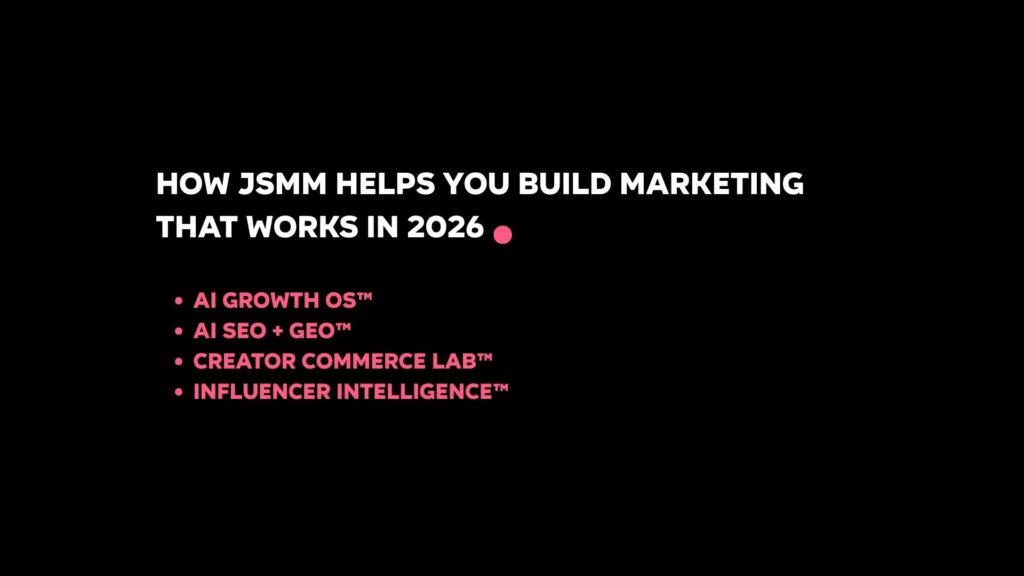
AI Growth OS™: A governed full-funnel growth system that connects strategy, paid media, funnels, AI and reporting around one KPI scoreboard.
Creator Commerce Lab™: A short-form video and UGC system that pairs creators, AI-assisted editing and DM funnels to turn content into leads.
AI SEO + GEO™: A visibility program that helps your brand show up more clearly in both Google and AI search platforms.
Influencer Intelligence™: An influencer and event strategy that helps you generate authentic content, measurable reach and stronger ROI.
How do leaders identify where AI creates leverage?
Leaders identify leverage by looking for areas where AI can improve speed, insight or efficiency without lowering quality. The best opportunities usually support decision-making, workflow performance or operational clarity.
What should businesses avoid when building an AI strategy?
Businesses should avoid rushing into tools, automating high-risk processes too early and using AI without clear ownership or review. A strong strategy also defines what should not be automated.
How can AI be used in marketing without hurting brand trust?
AI can support marketing without hurting brand trust when businesses keep human review in place for customer-facing content and set clear standards for voice, accuracy and quality. AI should support the brand, not speak for it unchecked.
When should a business work with an AI Growth Partner?
A business should work with an AI Growth Partner when it needs strategic clarity before execution begins. This direction is especially helpful when growth, marketing and AI decisions are aligned under a single plan.
CEO & Founder, Jennings Social Media & MarTech (JSMM)
AI-Powered Marketing Innovator | National Speaker | Award-Winning Agency Leader
Valerie Jennings is a transformative leader in digital marketing, known for pioneering AI-powered strategies that drive growth, innovation, and real business outcomes. She founded Jennings Social Media & MarTech (JSMM) in 2003 at just 24 years old.
Today, the agency serves a global client base ranging from publicly traded companies to small businesses across healthcare, technology, tourism, real estate, transportation, manufacturing, wealth management and medtech.
Under Valerie’s leadership, JSMM has developed and executed high-impact campaigns that combine AI-driven persona development, predictive analytics, geofencing, and digital advertising to deliver measurable results. One of her most successful campaigns for the Miami Beach Visitor Center resulted in a 115% increase in qualified leads, fueled by hyper-targeted creative and performance-based media.
In 2024, Valerie and her agency received 13 national and international awards, including:
🏆 Stevie Women in Business Award Finalist – Most Innovative Woman of the Year in Advertising, Marketing & PR
🏆 TITAN Women in Business Gold Winner – Innovative Marketing Executive of the Year
🏆 Cynopsis Top Women in Media – Industry Leaders, Senior Directors and Above
🏆 Inc. Magazine 2024 Power Partner – Recognizing JSMM’s trusted agency performance
She is also a national speaker on AI and digital transformation and holds an AI certification from Coursera, led by Dr. Andrew Ng, founder of DeepLearning.AI, co-founder of Coursera, and a Stanford computer science professor.
Valerie currently serves as chair of the Miami Beach Chamber of Commerce Tourism and Hospitality Council and leads a global team headquartered in Overland Park, Kansas, with satellite offices in Miami Beach, Florida, and Irvine, California. Her work continues to transform brands, inspire teams, and set the standard for what's possible in modern marketing.